
July 30, 2026
For years, Search Console has run on one unspoken rule: if you don’t own a website, you don’t get data. Verify a domain, prove ownership, and only then does Google let you see the queries, clicks, and impressions behind your content. If your entire audience lived on Instagram, TikTok, or YouTube instead, you were locked out, no matter how much traffic those posts were quietly pulling in from Google Search.
That rule just changed.
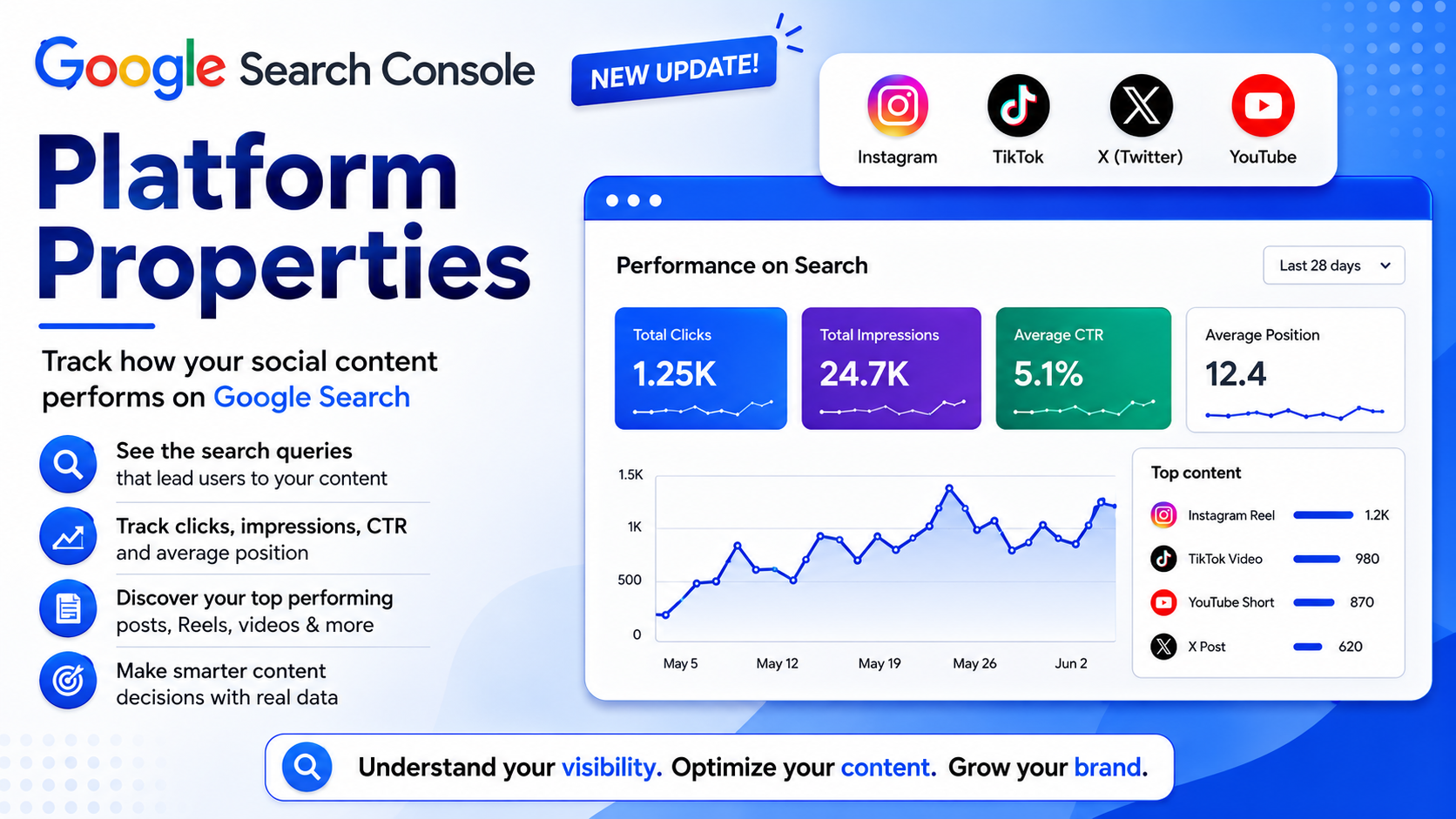
Google has introduced platform properties, a new Search Console property type built specifically for social and video content. For the first time, creators and publishers can verify a social media account, not a domain, and get the same kind of Search performance data website owners have had for years. As reported by Search Engine Journal, the update lets creators see which search terms lead people to their posts and how their audience interacts with that content, even if they’ve never launched a website.
It’s a small phrase, “verify an account instead of a domain”, but it quietly rewrites who Search Console is for.
What Exactly Are Platform Properties?
Think of platform properties as siblings to the domain and URL-prefix properties you already know. Instead of proving you own a website, you connect a social or video account, and Search Console starts tracking how that account’s content performs in Google Search and Discover.
At launch, four platforms are supported:
- TikTok
- X
- YouTube
Once connected, a platform property behaves almost exactly like a website property: same reporting structure, same filtering and export options, just pointed at posts instead of pages.
Why This Matters More Than It Sounds
It’s easy to read “new property type” and shrug. But the significance here isn’t the feature itself; it’s who suddenly gets access to it.
Search Console has always been a tool for website owners. Creators who built their entire presence on social platforms, which, for a huge and growing share of the internet, is where most creators are, simply had no equivalent. You could see follower counts and in-app engagement metrics, but whether your content was actually surfacing in Google Search results was a total mystery. No queries, no impressions, no way to know if your Reels or TikToks were earning organic visibility or were invisible to Search entirely.
Platform properties close that gap directly. For the first time, “does my content show up in Google Search” has a measurable answer — even if you’ve never touched a domain registrar in your life. This is genuinely the first Search Console property type verifiable without owning a website, and that’s a meaningfully different audience than the one Search Console was originally built to serve.
The Three Reports You’ll Actually Use
Once a platform property is verified, you get access to three reports, each built around the same performance data model Search Console has used for years, adapted for social content.
Performance Report
This is the core of the feature. It shows your total clicks, impressions, and related metrics, and lets you filter and sort to identify which specific posts and search queries are driving the most traffic. If you’d rather crunch the numbers in your own tool, the data is exportable too, useful if you’re already tracking performance across platforms in a spreadsheet or dashboard.
Insights Report
Where Performance is granular, Insights is the zoomed-out view. It surfaces recent traffic trends, your best-performing posts, and the different ways people are finding your account through Google Search. It’s the report you’d check weekly or monthly to spot patterns rather than individual post performance.
Achievements
This one’s lighter, a milestone tracker that flags progress like crossing a new total-click threshold within a rolling 28-day window. It won’t change your strategy, but it’s a nice signal of momentum, especially for creators just starting to pay attention to their Search visibility.
Setting One Up
The process mirrors Search Console’s existing verification flow, so if you’ve ever added a website property, this will feel familiar:
1. Open Search Console
2. Go to the property selector or “Add property” screen
3. Choose Instagram, TikTok, X, or YouTube
4. Follow the on-screen prompts to authorize the connection to your account
Once verified, data should start populating — though see the rollout note below, since not every account has access yet.
Don’t Confuse This With Search Profiles
Google also launched something called Search profiles back in June 2026, and the naming similarity trips a lot of people up. They’re related but serve completely different purposes.
Search profiles are public-facing pages, a shareable page that consolidates a creator’s content for their followers to browse. They’re the stage: something your audience actually sees.
Platform properties are the opposite. They’re purely for you, the creator, to understand how your content performs in Search. Nobody else ever sees this data. If Search profiles are the stage, platform properties are what happens backstage: the analytics you use to make decisions, not something you publish.
Eligibility differs too. Search profiles are limited to qualified creators and publishers with significant followings, while platform properties are rolling out more broadly to connected accounts regardless of audience size.
This Isn’t Coming Out of Nowhere
If this feels like a natural next step rather than a sudden pivot, that’s because it is. Google tested an early version of this idea back in December 2025, when it began surfacing limited social-channel data inside the Insights report of existing website Search Console properties. That version was automatic, constrained, and only available to people who already had a verified website; there was no standalone property for social content on its own.
Platform properties take that experiment and formalize it into a self-service property type that anyone can set up manually, with or without a website. It’s the same underlying idea, just built out into something creators can actually control and rely on.
What Rollout Actually Looks Like Right Now
Google has been upfront that this is a gradual rollout happening over several weeks, not a feature that flips on for everyone simultaneously. Early trade coverage has already noted that access is visibly uneven in the first days; some creators can add a platform property immediately, while others still don’t see the option in their account at all.
If you check and it’s not there yet, that’s expected and not a sign anything’s wrong on your end. Google has said to check back periodically, and there’s a feedback link inside Search Console itself, along with the Search Central Community, if you want to report issues or ask questions once access does land.
What This Actually Means for You
A few practical takeaways if you’re building an audience on social platforms:
- You no longer need a website to get real Search data. If your entire presence is on Instagram, TikTok, X, or YouTube, you can finally see how that content performs in Google Search, a visibility gap that simply didn’t have a solution before this.
- It’s a measurement tool, not a growth lever. Platform properties won’t index your content faster or push it higher in results on their own. It’s purely reporting. Any actual improvement in performance still comes from you acting on what the data shows you.
- Don’t overhaul your content strategy on day one. The feature is brand new, and the rollout is incomplete. It’s worth connecting your account and watching the data for a few weeks before drawing firm conclusions about what’s actually working in Search.
- It complements your website data, not replaces it. If you run both a website and social accounts, you’ll now be able to see Search performance across your entire footprint in one place, instead of guessing how your off-site content contributes to your overall visibility.
The Bigger Picture
Social and video content has been earning real visibility in Google Search and Discover for a while; the surprising part was always that there was no way to measure it if you didn’t own a website. Platform properties fix that by extending the same query-level data website owners have relied on for years directly to social and video posts.
It’s early, the rollout is still patchy, and how deep the data gets at scale remains to be seen. But the direction is unmistakable: Google is expanding Search Console beyond the domain-verified world it was originally built around, into the platforms where a growing share of content actually lives now.
If you’re a creator without a website, this is the first time Search Console has ever had anything to offer you. That alone makes it worth setting up the moment it becomes available in your account.